Spend $675 to unlock your gift!
$0
$90
Free Shipping
$675
Baking Sheet Duo
($120 Value)
Your Cart is Empty
Get started with the Caraway essentials!
Free Shipping On Orders $90+
Free Returns
30-Day Trial
Home & Kitchen with Caraway
Key Takeaways
Hard anodized cookware is aluminum treated through an electrochemical process to create a hard, sealed surface. Ceramic cookware uses a mineral-based nonstick coating over an aluminum or steel core.
The biggest difference isn't durability, it's what's actually coating the pan you cook on every night.
Ceramic skips synthetic coatings entirely, which is why it's the simpler choice if avoiding PFAS, PTFE, and PFOA matters to you.
If you've ever stood in the cookware aisle squinting at two pans that both claim to be "premium nonstick," you already know the problem.
Hard anodized and ceramic are constantly lumped together, like they're just two flavors of the same thing. They're not. They're built completely differently, they cook differently, and what's actually touching your food is different, too.
At Caraway , this comparison comes up all the time. Both materials show up in every "best cookware" roundup. Both promise durability and easy release. But the differences show up the moment you crack an egg, sear a steak, or scrub something stuck after dinner.
Let's break down what actually separates them so you can pick the one that fits your kitchen.
Hard anodized starts out as plain aluminum. Manufacturers run it through an electrochemical process: the aluminum sits in an electrolyte bath while an electrical current passes through it, which fuses oxygen to the surface of the metal. What's left behind is a layer of aluminum oxide that's noticeably harder and more stable than the aluminum underneath.
Here's the part people miss. That oxide layer isn't a coating sitting on top of the pan. It is the pan, just chemically transformed. That's why hard anodized cookware holds up so well against scratches and everyday wear.
Where it gets more complicated is nonstick performance. Raw anodized aluminum isn't especially slick on its own, so most hard anodized pans marketed for easy release have a second material layered over the anodized surface, usually a PTFE-based coating. That second layer is where most of the real safety conversation actually lives.
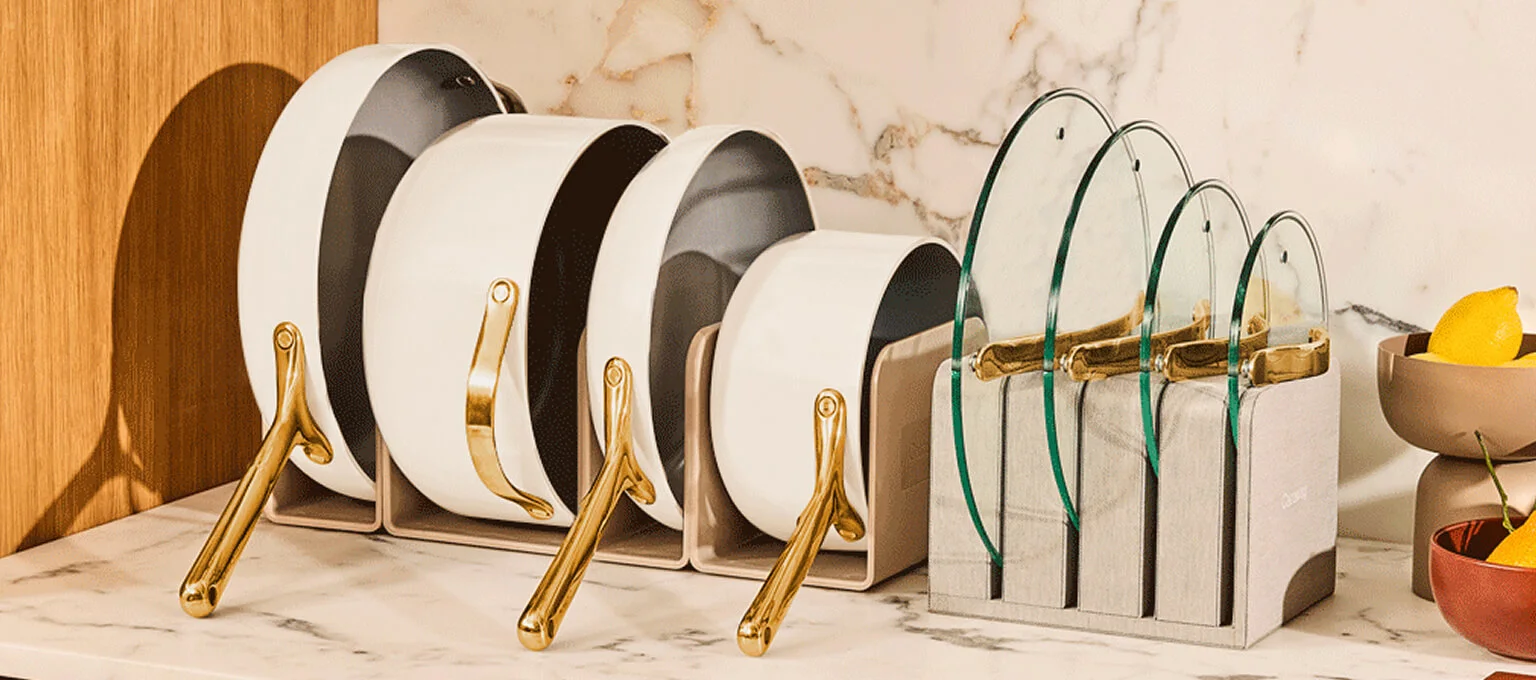
When people say "ceramic cookware" today, they almost always mean ceramic-coated. A metal base, usually aluminum or stainless steel, is coated with a mineral-based nonstick layer made of silicon and oxygen. That coating is applied through a process called sol-gel, then baked onto the pan at high heat until it bonds permanently to the surface.
The ceramic is just the top layer. The metal underneath is doing the actual work of conducting heat and giving the pan its shape and strength. This distinction matters because "ceramic" gets used loosely across the industry, and not every ceramic pan is built the same way. Some brands use a thin, low-grade coating. Others put real engineering into the layers underneath.
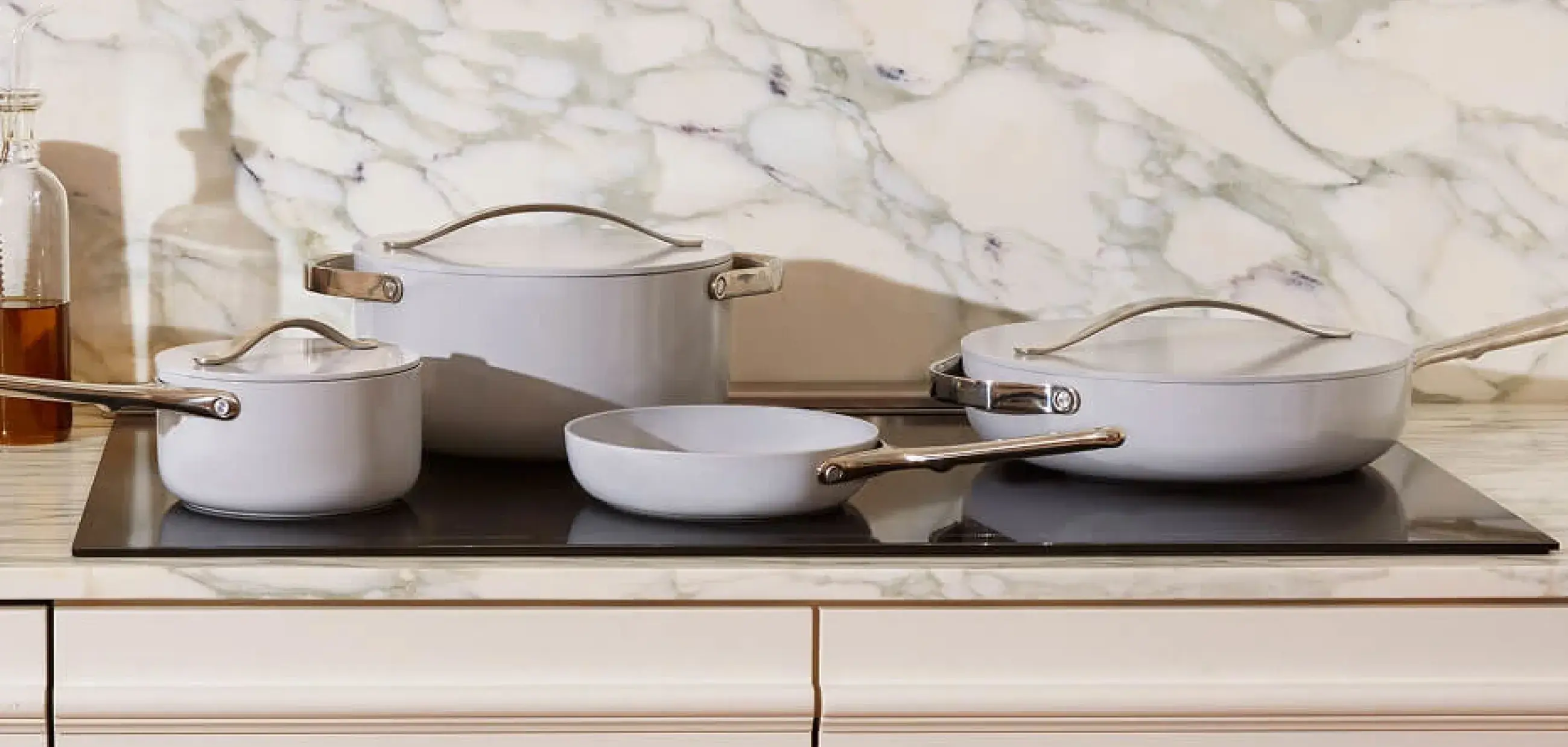
We built our Cookware Set around a recycled aluminum core with a stainless steel base plate, topped with a ceramic coating that's third-party tested for over 200 types of PFAS and 20+ heavy metals. You get the easy release of ceramic with heat performance that holds up night after night.
This is usually the real question underneath all the cookware shopping. Not which one looks nicer on the stove, but what you're actually cooking dinner on.
The anodized layer itself is fairly stable, but it's not bulletproof. Anodized aluminum can still shed small amounts of aluminum into food , especially when acidic ingredients like tomato sauce are used or when the surface is scratched.
Whether trace aluminum exposure from cookware actually matters for your health is still debated. The link between aluminum and cognitive decline hasn't yielded a clear cause-and-effect, and it's an area scientists are still actively studying.
The bigger question is what's layered on top. If your hard anodized pan is marketed as nonstick, there's a good chance that's a PTFE coating, and PTFE belongs to the PFAS family of forever chemicals tied to thyroid issues, liver problems, and increased cancer risk in long-term studies.
Once that coating scratches or breaks down, those chemicals can end up in your food and eventually the water supply, which is part of why the EPA finally set enforceable PFAS limits in drinking water back in 2024.
Ceramic coatings skip PTFE chemistry entirely. They're built from mineral materials, not fluoropolymers, so PFAS, PTFE, and PFOA aren't part of the equation from the start.
What actually matters here is what's underneath that coating and how transparent the brand is about it. Cheap ceramic pans can cut corners in the layers you don't see, which is exactly why we publish our third-party testing results instead of asking you to just trust the label.
Reading about materials is one thing. Cooking dinner on them is another, and this is where the two actually feel different in your hand.
Both hold heat well when they're built on a solid aluminum core, which is genuinely most of what makes a pan good. Hard anodized tends to tolerate higher heat without any drama, so if you like a hard sear, it won't punish you for cranking the burner.
Ceramic prefers to stay in the low-to-medium range. Push it too hot too often, and you'll shorten its nonstick life faster than you'd like.
That heat sensitivity is really the whole story of the learning curve. Hard anodized with a PTFE coating on top is more forgiving if you occasionally cook too hot or forget to preheat. Ceramic asks a little more of you: gentle heat, a bit of oil, some patience while it warms up.
Neither is as low-maintenance as stainless steel, which has no coating to babysit, but both are easy to get the hang of within a few cooks.
Fresh out of the box, both surfaces release food beautifully and clean up in seconds. Where they part ways is what happens after a year or two of regular use.
The anodized layer on a hard anodized pan is genuinely tough: scratch-resistant, corrosion-resistant, and built to take a beating.
But most of what you're paying for in terms of nonstick performance isn't that anodized layer, it's the PTFE coating sitting on top of it, and that's the part with the shorter shelf life. With proper care, that coating typically lasts 3 to 5 years.
Ceramic is more delicate by nature. The coating is thinner than PTFE, making it more sensitive to high heat, rough scrubbing, and aerosol sprays that build up into a sticky film over time. Treat it gently, and you'll usually get one to three solid years of peak performance before it's time to think about a refresh.
Here's the part worth remembering when either one starts to go: a worn ceramic coating just stops releasing food easily. It's not shedding anything harmful on its way out. A worn PTFE coating can flake or release compounds, which is the tradeoff for that longer lifespan.
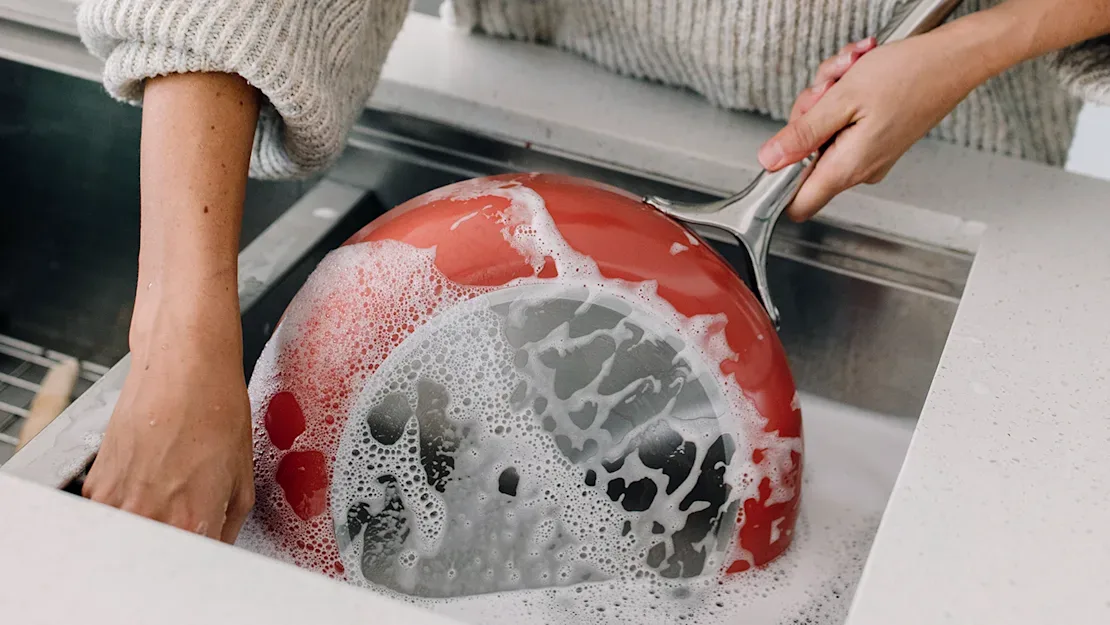
The care instructions overlap more than you'd expect.
For hard anodized:
Cook on low to medium heat.
Use wooden, silicone, or nylon utensils to protect the coating on top.
Hand wash with warm soapy water and a soft sponge.
Skip aerosol cooking sprays, which leave a sticky residue over time.
Let the pan cool before washing to avoid thermal shock.
For ceramic:
Cook on low to medium heat (ceramic is even more sensitive to high heat than hard anodized).
Use wooden, silicone, or nylon utensils. Our birch wood Utensil Set is built exactly for this.
Hand wash with warm soapy water and a soft sponge.
Skip aerosol sprays entirely. A little oil straight from the bottle does the same job without the buildup.
Let the pan cool naturally before washing.
A couple of habits help either pan, regardless of material: use enough oil (a tablespoon or two goes a long way, even on a nonstick surface), and store your pans with something between them, a rack, hooks, or even a folded dish towel, so they're not scratching each other in the cabinet.
This is a conversation that's shifting fast, and both materials have their own footprints to weigh. Hard anodized cookware production is energy-intensive and often relies on aluminum from virgin extraction, which has real environmental costs.
Cookware with PTFE-based nonstick coatings adds the environmental persistence of PFAS into the equation. Forever chemicals accumulate in soil, water, and living organisms, and they don't break down.
Ceramic cookware avoids the PFAS piece entirely. Our ceramic cookware is built on a recycled aluminum core, which reduces the impact of virgin aluminum extraction, and the packaging is made of recycled cardboard with no single-use plastic. When you're weighing environmental impact, the biggest lever is really whether the product involves forever chemicals or not.
Both categories span a wide price range, and the sticker price alone doesn't tell you the full story. Cheap hard anodized pans start around $30 to $50, while premium sets can reach several hundred dollars. Ceramic-coated cookware follows a similar range: cheap sets under $100, quality brands with third-party testing and thoughtful construction, and full sets in the $200 to $500 range.
The real cost-per-year math depends on lifespan. A premium hard anodized set might get you 5+ years before the nonstick surface needs replacing. A premium ceramic set might last 3+ years before the coating shows noticeable wear. Both beat disposable cookware by a mile, and both make sense financially if you're cooking regularly.
If you sear steaks on high heat, don't want to babysit the stove, and aren't bothered by a PTFE-based coating, hard anodized will treat you well. It's forgiving, durable, and built for people who want their cookware to keep up without much fuss.
If you'd rather your pan skip PFAS, PTFE, and PFOA altogether, cook mostly on low-to-medium heat (which, let's be honest, covers most weeknight dinners), and want a brand that shows its work instead of just claiming to be clean, ceramic is your answer.
Most home cooks end up wanting both. Ceramic for the everyday stuff: eggs, veggies, quick sautés. Something heavier duty, like our Enameled Cast Iron Dutch Oven , for the slow braises and the sear-then-simmer meals.
Hard anodized and ceramic are solving the same problem in two different ways. One toughens up aluminum and usually adds a synthetic coating for the nonstick part. The other skips synthetic coatings entirely and leans on mineral chemistry instead.
Neither one is going to ruin your life if you pick "wrong," but if you're trying to build a kitchen you feel good about, cook in, and actually trust, that distinction is worth knowing.
If you're ready to make the switch, our Cookware Set is a solid place to start. Third-party tested, built to last, and made without the stuff you don't want anywhere near your dinner.
It depends on what's coating the pan. Hard anodized aluminum itself is fairly stable, but if there's a PTFE nonstick layer on top, you're dealing with PFAS-family chemicals. Ceramic coatings are made without PFAS, PTFE, or PFOA from the start, which is why many people consider it the more straightforward option.
The anodized aluminum surface itself does not. But most hard anodized pans marketed as nonstick have a PTFE coating applied over that anodized layer, and PTFE is part of the PFAS family. Check the product description and look for third-party testing to confirm what's actually on the pan you're considering.
Hard anodized with a PTFE nonstick coating typically delivers peak performance for 3 to 5 years. Quality ceramic coatings typically maintain peak performance for 1 to 3 years. Both can be used beyond those windows, just with less nonstick performance.
You shouldn't. Metal utensils will scratch both ceramic and any nonstick coating on hard anodized aluminum. Wooden, silicone, and nylon utensils are the better choice and will noticeably extend the life of either pan.
Yes, generally, as long as the surface is intact. Both hard anodized aluminum (with the oxide layer sealed) and ceramic coatings are non-reactive, so tomatoes, citrus, and vinegar-based sauces won't pick up a metallic taste or damage the cookware. Raw, untreated aluminum is the one you actually want to avoid for acidic cooking.
Sources:
Aluminium and Alzheimer's: An Unproven Link | Alzheimer's Research UK
Assessing Leaching of Potentially Hazardous Elements from Cookware During Cooking | PMC
Yale Experts Explain PFAS 'Forever Chemicals' | Yale Sustainability
Per- and Polyfluoroalkyl Substances (PFAS) National Drinking Water Standards | EPA
Spend $675 to unlock your gift!
$90
Free Shipping
$675
Baking Sheet Duo
($120 Value)
Get started with the Caraway essentials!
Free Shipping On Orders $90+
Free Returns
30-Day Trial
Spend $675+ to unlock your free gift!
Exclusive Baking Sheet Duo for orders $675+
$90
Free Shipping
$675
Baking Sheet Duo
($120 Value)
Spend $675+ to unlock your free gift!
Exclusive Baking Sheet Duo for orders $675+
$90
Free Shipping
$675
Baking Sheet Duo
($120 Value)
